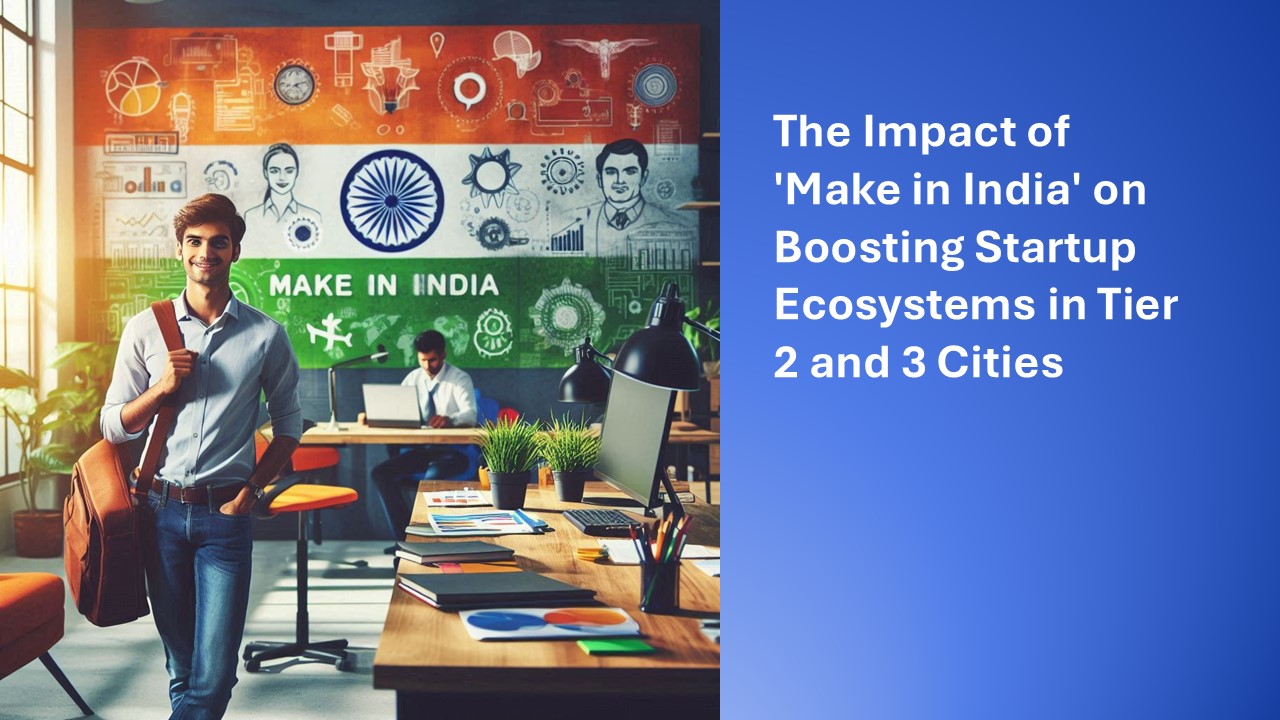
The Impact of ‘Make in India’ on Boosting Startup Ecosystems in Tier 2 and 3 Cities
Discuss how the initiative is helping to spread entrepreneurial activity beyond major cities, empowering startups in smaller towns and cities.
Launched in 2014, the “Make in India” initiative is a landmark effort by the Indian government to transform the country into a global manufacturing hub and boost economic growth across all sectors. While its early focus was primarily on manufacturing, the initiative has since evolved to encompass a broader range of objectives, including fostering entrepreneurship and innovation across the nation. One of the most significant impacts of “Make in India” has been its role in catalyzing the growth of startup ecosystems in India’s Tier 2 and Tier 3 cities. By extending the entrepreneurial wave beyond the major metropolitan centers, “Make in India” is empowering startups in smaller towns and cities, thereby democratizing access to opportunities and creating a more balanced and inclusive economic landscape. This essay explores the impact of the “Make in India” initiative on boosting startup ecosystems in Tier 2 and 3 cities and how it is shaping the future of entrepreneurship in India.
Decentralizing Entrepreneurship: A Shift from Metros to Smaller Cities
Historically, India’s startup ecosystem has been concentrated in major metropolitan cities such as Bengaluru, Mumbai, Delhi, and Hyderabad, which have traditionally offered the infrastructure, resources, and networks needed to foster innovation and business growth. However, this concentration of entrepreneurial activity has also led to challenges, including intense competition for talent, high operational costs, and saturated markets. Recognizing the need for a more balanced economic development, the “Make in India” initiative has sought to decentralize entrepreneurship by promoting the growth of startup ecosystems in Tier 2 and 3 cities.
Through targeted policies, incentives, and infrastructure development, “Make in India” has successfully encouraged startups to set up operations in smaller cities. These efforts have not only alleviated the pressures on metropolitan ecosystems but also unlocked the untapped potential of India’s vast talent pool in these regions. As a result, cities like Jaipur, Coimbatore, Indore, and Kochi are emerging as vibrant hubs of innovation, offering a conducive environment for startups to thrive.
Government Support and Policy Initiatives
A key factor driving the growth of startup ecosystems in Tier 2 and 3 cities is the strong support provided by the Indian government under the “Make in India” initiative. The government has introduced several policies and schemes specifically designed to promote entrepreneurship in smaller cities, including financial incentives, incubation support, and skill development programs.
For instance, the Atal Innovation Mission (AIM) has established Atal Incubation Centers (AICs) and Atal Tinkering Labs (ATLs) across the country, many of which are located in Tier 2 and 3 cities. These centers provide startups with access to mentorship, funding, and state-of-the-art infrastructure, enabling them to develop and scale their businesses. Additionally, the Startup India initiative, which is closely aligned with “Make in India,” offers tax exemptions, easier access to credit, and simplified regulations for startups in smaller cities, making it easier for entrepreneurs to navigate the complexities of starting and growing a business.
Furthermore, the government’s focus on improving digital infrastructure, such as expanding broadband connectivity and promoting digital literacy, has empowered startups in Tier 2 and 3 cities to leverage technology and innovation to compete on a national and global scale. By creating a level playing field, these initiatives have significantly lowered the barriers to entry for entrepreneurs in smaller towns and cities, fostering a more inclusive startup ecosystem.
Building Localized Innovation Hubs
One of the remarkable outcomes of the “Make in India” initiative is the emergence of localized innovation hubs in Tier 2 and 3 cities. These hubs are characterized by their focus on solving problems that are specific to their regions, thereby creating solutions that are not only innovative but also highly relevant to the local context.
For example, agritech startups in cities like Nashik and Ludhiana are developing technologies that cater to the needs of local farmers, such as precision farming tools, soil health monitoring systems, and efficient irrigation methods. Similarly, startups in healthcare, education, and logistics in smaller cities are addressing challenges related to access, affordability, and infrastructure, often in ways that are more practical and effective than those developed in urban centers.
These localized innovation hubs are also benefiting from the growing collaboration between startups, local industries, and academic institutions. Many Tier 2 and 3 cities are home to engineering colleges, agricultural universities, and research institutions that are partnering with startups to drive innovation and commercialization. This synergy is creating a virtuous cycle of knowledge exchange, technology transfer, and economic development, further strengthening the startup ecosystems in these regions.
Talent Retention and Job Creation
Another significant impact of “Make in India” on Tier 2 and 3 cities is its role in retaining local talent and creating employment opportunities. In the past, many skilled professionals and aspiring entrepreneurs from smaller cities were compelled to move to metropolitan areas in search of better career prospects and business opportunities. However, with the rise of vibrant startup ecosystems in their hometowns, these individuals are increasingly choosing to stay and contribute to the local economy.
The availability of opportunities in smaller cities is not only helping to retain talent but also attracting professionals from metros who seek a better quality of life, lower cost of living, and the chance to work in a less saturated market. This reverse migration is enriching the talent pool in Tier 2 and 3 cities, leading to the creation of high-quality jobs and driving economic growth.
Moreover, startups in these cities are playing a crucial role in addressing local unemployment by providing jobs in sectors such as IT services, manufacturing, and e-commerce. The ripple effect of job creation extends beyond direct employment, as startups also generate demand for ancillary services, such as logistics, marketing, and customer support, further stimulating the local economy.
Fostering a Culture of Entrepreneurship
The “Make in India” initiative has also played a pivotal role in fostering a culture of entrepreneurship in Tier 2 and 3 cities. By promoting success stories of startups from smaller cities and offering recognition and rewards for entrepreneurial achievements, the initiative has inspired a new generation of entrepreneurs to take the plunge and start their own ventures.
The rise of entrepreneurial networks, co-working spaces, and startup communities in these cities is further contributing to the growth of a vibrant startup culture. These platforms provide entrepreneurs with opportunities to connect, collaborate, and learn from each other, creating a supportive ecosystem that nurtures innovation and risk-taking.
In addition, the growing presence of angel investors, venture capitalists, and government-backed funds in smaller cities is providing startups with the financial backing they need to scale their businesses. This access to capital, coupled with the availability of mentorship and business development support, is helping startups in Tier 2 and 3 cities to overcome challenges and achieve sustainable growth.
The “Make in India” initiative has had a profound impact on the growth of startup ecosystems in Tier 2 and 3 cities, driving the decentralization of entrepreneurship and empowering startups across the country. By providing targeted government support, fostering localized innovation hubs, retaining talent, creating jobs, and nurturing a culture of entrepreneurship, “Make in India” is transforming smaller towns and cities into thriving centers of economic activity.
As the initiative continues to evolve, the potential for further growth in these regions is immense. By leveraging the opportunities provided by “Make in India,” startups in Tier 2 and 3 cities can not only contribute to their local economies but also play a significant role in driving India’s overall economic development. In doing so, they are helping to build a more inclusive, balanced, and resilient startup ecosystem that benefits the entire nation.